It was the Roaring Twenties.
Things were happening in America that had never been seen before. Flappers were dancing, automobiles were on the road, and WWI had just ended, kicking off the decade with a mood of excitement.
 |
| http://www.impetustoanalysis.com/2010/04/509/ |
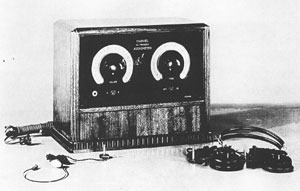
I believe that as time passed on and new generations followed WWI, the Roaring Twenties became a time of new entertainment inventions such as the Radio. With so much happening in society, the world needed some sort of outlet to receive entertainment and news. The audience demand of the twenties had a significant impact of the growth of the Radio due to the rise of new ideas and forms of entertainment popping up all over the world.
 |
| http://entertainment.howstuffworks.com/radio-show.htm |
In the twenties, the hair dryer was invented. In the twenties, Kool-Aid was invented. In the twenties, the traffic light was invented. With all these inventions, it was inevitable that some cool new invention was going to be made that would forever change the world. However, a major influence on society in the Twenties was actually invented many years before. It was called wireless telegraphy and was invented by Gugliemo Marconi in 1895. Over time, this concept would be morphed to something we would eventually use modernly. In 1916, American inventor Lee De Forest would transmit the first radio news broadcast via 'radio.' This new concept of informing/entertaining the public became a high demand. With new music being demanded by an eager audience, an outlet was desperately needed to deliver the frequencies to the receiver. With the Radio, music for the new generation could be he heard with a simple scanning of stations. As the world became interested in knowing news the minute it happened, a simple broadcast could air that would address the public.
 |
| http://entertainment.howstuffworks.com/radio-show.htm |
The radio became the way of life as seen in the movie "Radio Days." Public demand demanded a new outlet to receive their dose of information, whether it be music or news. People would tune in to hear the new 'Lone Ranger' program or to catch songs made by the famous Louis Armstrong. With this public demand on the rise, a new market was being developed. The Radio now was a source of entertainment in the twenties and could be seen with all of the forms of advertisement that could be heard on it. Between 1923 and 1930, 60 percent of American families purchased radios. Families gathered around their radios for night-time entertainment just as families now days gather around the television to watch a show or surf the internet on the family desktop. As new technologies continue to be made, public demand will always be close behind as people always are interested in the next best thing and eager to get the latest trend or fashion. This is just the way our world works. In 1927, radiotelephony linked North America and Europe commercially, proving just how farfetched this simple idea had become. The public needed ways of communication and saw this opportunity as a great outlet.
 |
| http://www.thepunch.com.au/tags/radio/ |
To this day, we continue to use the radio but for different reasons than those in the Twenties. For instance, instead of listening routinely the radio for everything as they did back then, we listen to the radio mainly for information on the road or to bump up the new jams that are popular. Public demand has mainly left frequencies and switched over to bandwidth as King Internet continues to make his mark in society today.
Bibliographies:
http://xroads.virginia.edu/~ug00/3on1/radioshow/1920radio.htm
http://www.answers.com/topic/when-was-the-radio-invented


