Sunday, October 31, 2010

Three Act Structure

In movies, the Three Act Structure suits many plots with their beginnings, middles, and ends. In the beginning, the movies introduce the setting of the story, the characters, and a little opener to what the movie is going to be about. In the middle, some sort of conflict begins to form. The end is also very important to the Three Act Structure because there we find the resolution to this conflict. Movies have different and distinct ways of showing the Three Act Structure. The movie I decided to use  to show the Three Act Stucture was Finding Nemo because I believe it has the "Happy Ending Structure" Disney loves to use in it's movies that appeal to kids.


http://pixarblog.blogspot.com/2010/07/disney-registers-finding-nemo-sequel.html


In the beginning of Finding Nemo, we are introduced to a certain Clown fish named Marlin who is flirting with his wife Coral as they gaze at their baby eggs. We see the setting in a coral reef under the Ocean in an area called The Dropoff. However, chaos strikes as a Swordfish kills Marlin's wife and unborn babies, leaving only one who he eventually names Nemo. This beginning is very crucial for the movie as it explains who the two main characters are, the setting of the story, and the behaviors of the characters and why Marlin acts so strict and is so paranoid on losing his son.

Eventually we see a conflict unfold in the middle of the movie as Nemo is accidentally taken away by a scuba diving dentist. This action sets in forth the plot by having Marlin embark on the incredible journey coined as "Finding Nemo." Through a series of adventures along with his new slightly confused and forgetful friend named Dory, Marlin heads all across the ocean in search of his son. sharks, jellyfish, underwater bombs, whales, a deep sea Anglerfish, seagulls, or crabs can not keep this determined father from searching for his son at P. Sherman 42 Wallaby Way, Sydney. Meanwhile, Nemo is held captive in an aquarium as we are introduced to new characters, all of which whom are in the aquarium with Nemo, hoping one day to be let free into the ocean.

The ending overall is the best part of the Three Act Structure, being as it involves the resolution to the conflict that arose in the movie. Without an ending, the audience would be left curious and without closure of the problems in the movie. Marlin and Dory receive a tip from a Pelican that his son is in a Dentist office in Sydney.  With heroic actions, Marlin flys to the dentist's office and although he mistakes his son to be dead at first, he soon realizes that Nemo is alive and well. Alas they are reunited as a family again, along with the new additions to the family they made along the journey. This ending proved to be very Disney-esk as it builds up a fluster of emotions right before it hits you with the "Happy Ever After" ending at the end, which typically seems to be the very common Three Act Structure in Hollywood and especially in Disney Pixar movies.

Monday, October 25, 2010

Sitcoms

The sitcoms that are on television play a major part in people’s lives all over the world. They allow for real world situations to be displayed on television in a more comedic way and it allows for a resolution usually at the end of the 30 minute time slots they hold


http://loyalkng.com/2009/05/30/fresh-prince-intro-mixed-cave-story-theme-soing/


Sitcoms typically go about a Three-Act-Structure.


1. The setup introduces the setting and the characters to the audience.


2. The conflict introduces the problem between the characters in the show.


3. The resolution, which includes the climax, resolves the issue that was brought up.


Sitcoms usually follow this method because it allows for a quick and enjoyable episode that involves some life-learning material. These sitcoms allow for the audience to in a way learn a lesson brought up in one’s life and shows way to go about it. This can explain how the same situations are seen throughout different sitcoms. For example, the issues of relationship problems and body issues make for great episodes to a sitcom and can be seen throughout many shows.


Some of my personal favorite sitcoms are George Lopez, Fresh Prince of Belair, and Malcolm in the Middle. These shows all deal with issues within a family but go about it in a humorous way using the three-act structure to go about resolving the issue. These shows all allow for us as the audience to experience problems that are not our own and still enjoy them in a way that makes our lives easier. These shows provide entertainment as we experience what the characters experience in a comedic way.


Sunday, October 17, 2010

Iceberg Ahead!

The movie I chose to analyze scenes was none other than 


Titanic


 The first shot in the Sinking scene was a long shot. The narrator chose to allow the audience to visualize this massive ship from a distance to perceive how a sinking ship would like in an ocean. The scene is level with the water which allows the audience to compare the actual angle of the ship with respect to the ocean. I would say that this scene is connotative because it focuses on the isolation of the sinking ship out in the middle of nowhere. From the view of the sky, it can be assumed that this happens in the nighttime.


 The second shot is a medium shot. It shows us a closer shot of the characters in the movie. These people are clearly running for their lives as they are realizing the danger of the situation. This medium shot gives us information as to how the people on a sinking ship would react. It is an overview shot I believe to allow the audience to see just how many people this is affecting, almost to give a head count of the passengers on the ship. With the medium shot, we see less of the big picture, but more of the small picture.


 The close up shot is considered by many to be the most important shot due. This shot allows for us to connect with the actors as we see their emotions fully and close-up. In the Sinking scene of The Titanic, we can only fear with Rose as she realizes that she is falling into the ocean. Her face captures the pathological connection with the audience as she fears for her life with Jack. The shot is at eye-level which allows for the audience to connect with the characters.

Sunday, October 10, 2010

Starstruck

Back in the day, during the Classical Hollywood Film period in history, many movies were judged according to the type of actors in a particular movie. People would want to go see a movie if their favorite actor or actress was the star of it. This system was called the Star System. This specific aspect of the studio system was very important, for without it, the audience of that era would not go to see movies.

According to Wikipedia.com, The Star System way a way of creating, promoting, and exploiting movie stars in Classical Hollywood Cinema. The Film studios would select young actors and actresses and basically create the character they wanted the audience to see by glamorizing them and making them the way the studio wanted them to be. This affected the kind of films the studio made because with such emphasis on the actor or actress, it had a huge reputation to uphold in its many movies.

I see this as the biggest impact of the Studio system because it was around this era that the film studios began to move from caring about the acting to caring more about the beauty and persona of the character. Once a studio had the beautiful and most appealing actor or actress, it would then train them to act and sing. Actors and Actresses had a contract to the studios so they were never allowed to leave a house without the makeup or attitude the studio wanted them to portray. This differs from today because nowadays, casting studios focus much more on the talent rather than the beauty, although beauty seems to come down the road anyways. However, this was the beginning of a studio era where new ideas were being done. With the help of the Star System, many film studios began to have faces being connected with their movies now that their films had reputations to uphold.

One cliche example of the Star System is none other than Judy Garland, who was discovered by MGM when she was just a young girl. Since then, they would create a persona for her and glamorize her as she matured into adulthood. Her stardom rose as she was greatly glamorized for her many film roles in MGM, including her biggest and most reputable role ever, “The Wizard of Oz.” With this role, it was clear just how big Judy Garland’s stardom was and how important MGM’s Star System role was to her career.
http://www.fanpop.com/spots/judy-garland

The Star System can still be seen today, although not as direct. Disney uses it’s own type of Star System by casting children at a young age and allowing us as an audience to see them grow up Disney. Miley Cyrus is a perfect example of the Star System because everything she does has to be associated with Disney. For instance, when she took controversial photos for a magazine cover, it is Disney who had to cover for her since she is so heavily glamorized for the company. Her tie to the system shows the importance that the Star System still has on many actors and actresses today as it did back in the Classical Hollywood film era.

Sunday, October 3, 2010

All in the Family Guy


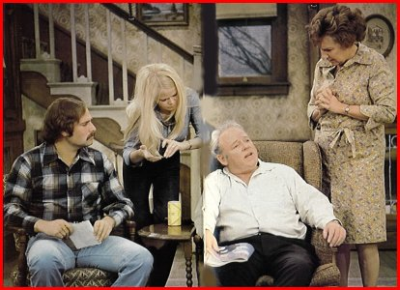
Shows back in the days are extremely different than the shows of today. Family-Based TV Situation Comedy shows are usually based on political influence and categorized according to the hegemony of its era. For example, although shows such as “All in the Family” and “Family Guy” both deal with families living in society, due to the conflicting eras of the shows, similar situations can both have differing conclusions. 


"All in the Family"

allinthefamily11
http://nocureforthat.wordpress.com/2010/01/12/all-in-the-family


"Family Guy"

http://www.planet-familyguy.com/news/familyguy/?c=Television


How is it different: 

The contemporary family-based television shows that I chose to compare and contrast are “All in the Family” and “Family Guy.” The show “All in the Family,” which started in the Seventies, has major differences than the modern-day television show “Family Guy.” The show “All in the Family” deals with a middle class family dealing with the ideas and actions of the Ronald Reagan era, a time where conservatism was high on the rise. The viewpoints of the main character of the show, named Archie Bunker, differ than everyone else he comes into contact with, showing the audience of the time just how conservative and anti-liberal he truly is. For example, in an episode that we watched for our RTF 305 screening, we saw how Archie thought that homosexuals were considered very taboo to his society and how they are seen as outside of the norm. He described gays as “queer,” “fairies,” and “girly.” He refused to believe and accept that his guy best friend he has known for a while was truly a homosexual. His own beliefs clashed with his unexpected situation and was forced to accept his friend as he truly was. This conservative view on life differs greatly than the views seen on modern day television show “Family Guy.” Peter is a father who deals with unexpected occurrences throughout the show. One difference of these two shows is that Peter and his family are very more liberal and accepting than the Bunker family’s views. In one episode, Peter’s daughter Megan tells her family that she believes that she is a lesbian. Even though her claims were later not true, her family still accepted the idea that even though she is lesbian, she was still her daughter regardless. This shows that how over time, views of the nation greatly shifted from very strict to more accepting. 

How it is the same:

Although these shows differ due to the era-based hegemonies and societies of the times, “All in the Family” and “Family Guy” also have some similarities. Both of the shows focus on middle-class families making their way in the world with their jobs in America. This demonstrates how the show’s focus of interest was to appeal to the large middle class working families, which has always been the majority in America. These two episodic television shows are also the same because current events at the time shape how family members think. Their beliefs and thoughts are usually influenced by society and it’s political influence at the time. The wives of the two main character males are also the same. Feminist views of both television shows demonstrate how women think a lot a like despite being in different eras in history.  Edith Bunker and Lois Griffith are both the accepting woman who are accepting of others. At the end of the day, the families love one another and will always accept them for who they are, even if it is more tougher for some than others. 
http://www.insidesocal.com

Some issues that “All in the Family” deals with that “Family Guy” doesn’t is the struggle for acceptance. Sure, there is some struggle for acceptance seen throughout “Family Gu  y,” but it is not seen nearly as much or as serious as in the conservative show “All in the Family.” In modern days, homosexuals are seen more commonly and less taboo in television shows and in society. A small example of another issue is when Archie did not want to miss the fight on television and felt that he needed to watch that show at that second since he can’t be able to later. This problem has been solved in today’s society with a little thing called “DVR” which can record shows that you might miss. 
Some issues that “Family Guy” deals with that “All in the Family” does not is internet dangers and electronic threats seen massively in the past decade. With new technology being made over time, it is easy to see how things such as Sexting, Internet lurers, and Pornography are issues seen more commonly in modern-day family based television shows than in earlier era shows. 


I also included a video to show Peter's reaction to his daughter telling him that she is a lesbian. Instead of not accepting Meg for who she claims she really is, he finds her newfound self discovery "awesome." This shows how cultures and eras in television have greatly changed since the days where conservative views on homosexuals were displayed negatively on television.